

Warranty leakage often isn’t caused by policy—it’s caused by execution across disconnected systems, manual reviews, and fragmented workflows. In an upcoming MAPconnected webinar discussion with Stellantis & ServiceNow, OEM leaders will examine how manufacturers are reducing claim leakage and improving margin across the warranty lifecycle.
This discussion is also informed by the AI-SWLM Think Tank—a member-driven initiative focused on moving AI from concept to execution through real use cases and Proof of Concept deployments across the service and warranty lifecycle.
Warranty Leakage Is Still Costing OEMs Margin. Here’s Where It Happens.
Warranty costs aren’t just rising—they’re quietly eroding margin in ways many organizations still struggle to fully see.
Across OEMs, the gap between what is paid and what should be paid on warranty claims is often measured in percentage points of revenue. Not because policies are unclear, but because execution breaks down across fragmented systems, manual reviews, and disconnected workflows.
The result is leakage that accumulates across the lifecycle—from claims intake and validation to approvals, recovery, and supplier accountability.
This is the focus of an upcoming MAPconnected webinar, powered by ServiceNow:
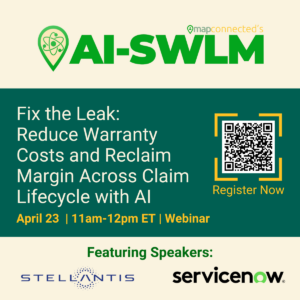
Fix the Leak: Reducing Warranty Costs and Reclaiming Margin Across the Claims Lifecycle
April 23 | 11:00 AM – 12:00 PM ET | Virtual
Why Warranty Leakage Persists
Most warranty leakage doesn’t happen because of a single bad decision. It accumulates across the lifecycle, across systems, and across teams that aren’t working from the same data.
Claims come in and get reviewed in isolation, without visibility into patterns across models, plants, or suppliers. Validation logic that should be consistent gets applied manually, which means it gets applied inconsistently. By the time a recoverable cost reaches the supplier, the window for recovery has often narrowed or closed.
Root cause data exists somewhere. Supplier accountability exists on paper. But when the systems handling claims, parts, and supplier performance don’t talk to each other, the discipline required to close the loop rarely survives contact with volume and time pressure.
That’s the execution gap. And it’s where most of the margin goes.
Addressing this execution gap is a core focus of the AI-SWLM Think Tank, where OEMs and industry leaders are working to apply AI in ways that improve consistency, visibility, and decision-making across the claims lifecycle.
What Leading OEMs Are Doing Differently
Leading manufacturers are starting to close the gap by looking at the claims lifecycle as a system, not a series of steps.
Common themes include:
• Connecting claims data across systems and stakeholders
• Embedding supplier accountability into workflows
• Using AI-assisted review to reduce manual effort
• Automating decisions where consistency matters most
Many of these approaches are being actively explored through the AI-SWLM Think Tank, a member-driven initiative focused on developing and testing real-world AI use cases across the service and warranty lifecycle. These efforts are already impacting how quickly claims move, how accurately they are paid, and how effectively costs are recovered.
Real-World Perspective from OEM and Technology Leaders
This session brings together both OEM and platform perspectives to ground the discussion in real execution.
Jerome Clerc
IT Domain Manager, Aftersales – Warranty & Recall Campaign, Stellantis
Abhi Rele
Head of Product, Manufacturing, ServiceNow
Together, they will discuss how manufacturers are modernizing claims processing, reducing leakage, and improving supplier recovery without disrupting existing systems.
What You’ll Take Back
This session is designed for leaders responsible for warranty performance, cost recovery, and operational governance, and reflect areas currently being advanced within the AI-SWLM Think Tank through active OEM collaboration and use case development.
Topics will include:
• Where leakage typically occurs across the claims lifecycle
• How AI and workflow automation are being used today
• What a realistic improvement path looks like over the next 12 months
• Where to start without replacing your entire system
Join the Discussion
Warranty leakage is rarely caused by one decision. It happens across systems, handoffs, and workflows.
Addressing it requires better visibility, stronger process discipline, and more connected decision-making across the lifecycle.
Fix the Leak: Reducing Warranty Costs and Reclaiming Margin Across the Claims Lifecycle | April 23 | 11:00 AM – 12:00 PM ET | Virtual
🔗 Reserve your spot and learn how leading OEMs are protecting warranty performance and margin.
See how OEMs are applying AI in real operations. Explore the AI-SWLM Think Tank and request to participate.
Subscribe to MAPconnected’s weekly newsletter to stay informed on upcoming peer sessions, benchmarking topics, and the industry signals service and warranty leaders are tracking inside MAPconnected.