

By Karan Singh

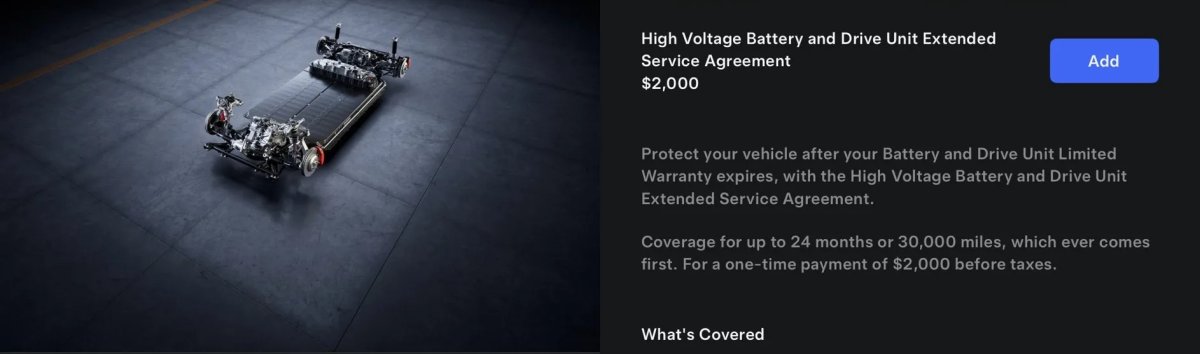
For owners planning to keep their Model 3 or Model Y for the long haul, Tesla has quietly released a new warranty option. The introduction of a High Voltage Battery and Drive Unit Extended Service Agreement in the United States and Canada will allow owners to extend coverage on the vehicle’s most expensive components for a flat fee of $2,000 USD / $2,800 CAD.
Previously, Tesla’s other Extended Service Agreements (ESA) focused on the general vehicle limited warranty. This new standalone ESA targets the powertrain – the heart of your EV – and offers an additional buffer against potential failure after the standard 8-year warranty expires.
Cost and What’s Included
The new ESA is priced in with a one-time purchase (no subscription is offered at this time). In exchange for $2,000 USD, Tesla will extend the coverage of your High Voltage Battery and Drive Units by:
-
24 Months, or
-
30,000 Miles (48,000 KM)
This new coverage kicks in immediately after your original Battery and Drive Unit Limited Warranty expires.
Deductible
It is important to note that, unlike the original warranty, this extension comes with a deductible. If you need a repair or replacement under this ESA, there is a $500 deductible per visit. However, given that a full battery replacement can cost between $10,000 and $15,000 USD, the deductible is a manageable cost for most owners.
No Grace Period
Another item that’s critical to note is the eligibility window. There is absolutely no grace period for this warranty offer. You must purchase this ESA before your vehicle’s original Battery and Drive Unit Limited Warranty expires. Once that original warranty period lapses, whether by a day or a mile, your vehicle is ineligible for the extended coverage.
Coverage Limits
The ESA covers the repair or replacement of the High Voltage Battery and Drive Unit (which will both be either manufactured or supplied by Tesla) to correct a failure during the coverage period.
However, the text also specifies that parts external to the Battery and Drive Unit are not covered. This likely includes parts such as the 12V low-voltage battery, charging ports, or high-voltage cabling external to the pack itself.
How to Check Eligibility & Buy
You can check if your VIN is eligible directly in the Tesla App.
Simply open up the App, then navigate to Upgrades > Service Plans, and look for High Voltage Battery and Drive Unit Extended Service Agreement.
If your vehicle is eligible, you will see the option to purchase.
Transferability
A significant benefit of this ESA is peace of mind, but another one is transferability. If you sell your Model 3 or Model Y privately, the remaining coverage will transfer to the new vehicle owner once the transfer is processed by Tesla.
This could be a strong selling point for used vehicles that are just pushing close to the original vehicle battery warranty, which could help alleviate buyer anxiety about battery health.
Other Vehicles & Regions?
Tesla has not mentioned whether its flagship and halo vehicles – the Model S and X, as well as the Cybertruck – will receive this particular Extended Service Agreement.
The Model S and Model X already have access to the comprehensive ESA that covers other vehicle parts, so we expect this one, which covers the powertrain, to arrive sometime in the near future. The Cybertruck remains the standout vehicle without any additional coverage at this time, but this will likely change as the Cybertruck gets older and more vehicles pass the original warranty.
For other regions outside of North America, Tesla previously said that its ESA program would be extended to Europe and Asia-Pacific in the future, so you can look forward to it sometime in 2026.
By Karan Singh
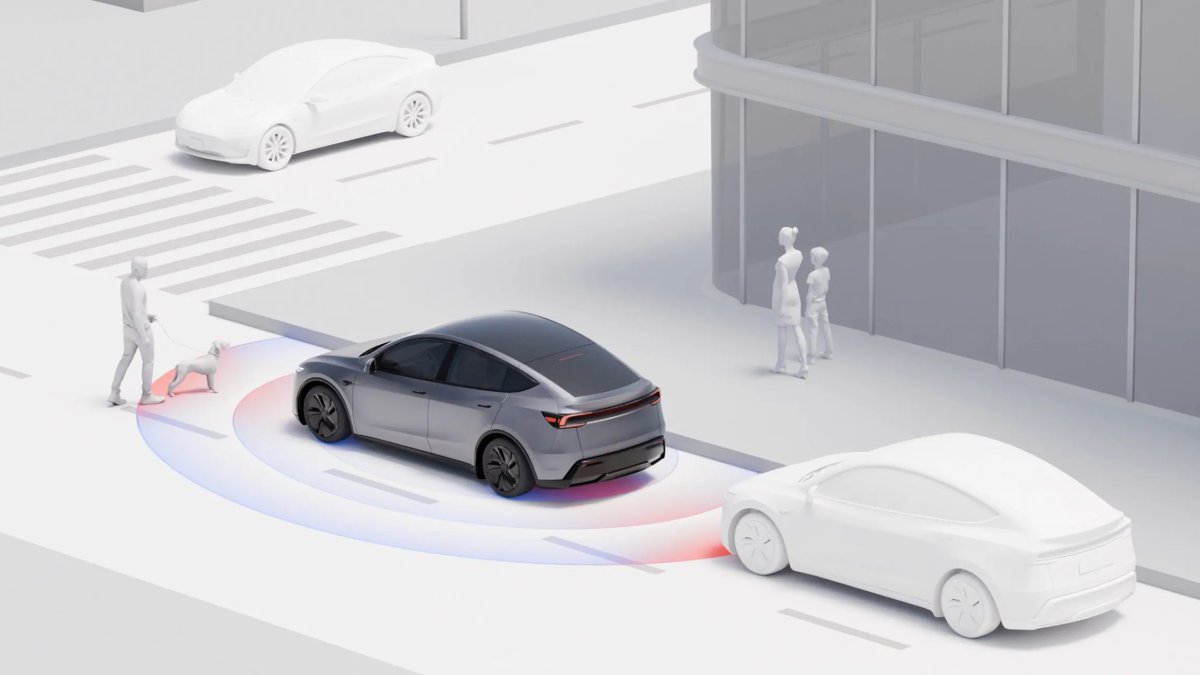
Tesla has officially launched a revamped Safety page on its website, designed to provide a detailed overview of how its vehicles protect not just the people inside them, but everyone – and everything – outside.
The new hub consolidates years of crash-testing data, active-safety features, statistics, and diagrams into a single, easily understandable webpage. It sits alongside the recently launched FSD Safety hub as another means to easily convey safety information to customers and potential customers.
Occupants, Road Users, & Wildlife
In a post on X announcing the new page, Tesla highlighted a specific triad of protection:
New Safety page on our website has an overview of how your Tesla protects everyone – occupants, other road users & wildlife alikehttps://t.co/pmekvoecrF pic.twitter.com/2RM0SD0KEV
— Tesla (@Tesla) December 19, 2025
While occupants and road users (such as pedestrians and cyclists) are standard metrics for safety organizations, the explicit inclusion of wildlife is something rather new. It highlights the capabilities of Tesla’s active safety systems based on vision to classify and react to animals – whether it be a small dog or a large deer – often faster than a human driver can at night.
The site is a deep dive into Tesla’s safety-first philosophy, breaking down the technology into key pillars.
The Hardware
The section on Passive Safety details the physical engineering that’s designed to protect occupants during a crash. Central to this is the way that each and every Tesla is built – the floor-mounted battery pack that lowers the vehicle’s center of gravity, significantly reducing the risk of rollovers.
Without an internal combustion engine in the front, Tesla vehicles also feature large crumple zones that absorb impact energy effectively, all before it reaches the cabin. The page also highlights the patented side sill structures that help absorb energy, protecting both the occupants and the battery pack.
Alongside other features like advanced airbag systems like the far-side airbags, active venting, and camera-based seat-belt tightening, Tesla makes some of the safest vehicles in the world if you’re in an impact.
The Software
However, simply stepping into a Tesla statistically reduces your likelihood of getting into an accident. After all, the safest crash is no crash. Tesla’s Active Safety features are showcased as standard on all Teslas, emphasizing that safety is not an optional extra.
The software suite includes Automatic Emergency Braking (AEB), which Tesla continues to improve, can detect cars, pedestrians, or cyclists and reduce or mitigate impacts, and Lane Departure Avoidance to steer the car back if it drifts.
In combination with Obstacle-Aware Acceleration, a feature designed to automatically reduce motor torque when an obstacle is detected in front of the car at low speeds and Forward Collision Warnings (soon able to be disputed if you have Tesla Insurance), Tesla’s software is focused on making the entire experience as safe as possible for both occupants and other road users.
Other features, such as Dynamic Brake Lights that flash rapidly during sudden stops, help to warn other drivers of a potential incident. Park Assist, Blind Spot Monitoring, Drowsiness Detection, and Autoshift help prevent accidents before they happen.
Safer Aftermath
Safety doesn’t stop suddenly when you’ve crashed. When you’re in a Tesla and a serious collision is detected, your hazard lights will automatically turn on, your doors will automatically unlock, and in certain regions, your vehicle will call 911 automatically and relay information to operators to get emergency services to you. We recently covered what to do in a Tesla if you’re in an accident.
Fire Safety
Addressing a common misconception and public concern, the page provides clear data showing that Tesla vehicles are approximately 10 times less likely to catch fire per mile driven than the average ICE vehicle.
Tesla explains the battery’s passive thermal protection system, which is designed to direct heat away from the cabin in the rare event of structural damage, reinforcing the argument that EV architecture is fundamentally safer regarding fire risk than vehicles carrying tanks of flammable fuel.
Real-World Data
Finally, Tesla also prominently displays their quarterly safety reports on the new Safety hub, which compares miles driven per accident with Autopilot (and FSD) against the US average. The latest data emphasizes that drivers using FSD (Supervised) experience collisions far less frequently than the national average for manually driven cars.
This data-driven approach aims to prove that Tesla’s technology is statistically safer than human drivers, turning safety from a promise into a real-life metric.
By Karan Singh

Despite software improvements earlier in 2025, it appears that the saga of the Cybertruck’s massive windshield wiper – affectionately known as the Gigawiper – is far from over.
According to a new Tesla Service message shared by an owner, Tesla has officially opened an active Engineering Investigation into the wiper’s performance, going so far as to replace entire wiper arm assemblies while waiting for a more permanent solution.
Tesla already replaced the original V1 arm assembly on many early Cybertrucks with a V2, but according to certain service staff, a V3 arm assembly is already in early testing stages.
Gigawiper’s Giga Challenges
The Cybertruck features the largest single wiper on a passenger vehicle, a massive 4-foot-long blade designed to clean the massive, flat expanse of the truck’s windshield. However, the component has been a frequent source of frustration for many owners.
Early units faced a recall in June 2024 due to faulty wiper motors, but complaints have persisted regarding the wiper’s actual cleaning ability, especially in colder weather. Owners have reported several issues with the blade, including improper stowage at high speeds, poor contact at the top and middle of the stroke, and fluid issues.
The improper stowage issue occurs at high speeds when the wiper doesn’t stow away at the correct angle and instead sits slightly over the visible edge of the windshield, slightly obscuring vision.
Poor contact issues are the most common, with the blade not cleaning over the forward-facing FSD cameras and the passenger’s half of the windshield not effectively cleaned, often leaving FSD unavailable in salty road conditions.
Finally, many are noting that, with wiper changes, kinks in the hose assembly or improperly tightened fittings are causing the washer fluid to dribble or leak rather than properly spraying, which contributes to the cleaning issues.
Software vs. Hardware
Tesla attempted to address some of these behaviors via OTA updates, all the way back on update 2025.2.8. This included changes to the wiper’s logic that made the movement crisp and improved how it stowed away. However, the new service document suggests that software alone cannot fix the problem.
The service note confirms that Tesla is conducting an investigation and will reach out to customers when a solution is available. While not always a direct indication, Engineering Investigations often lead to manufacturer-initiated recalls.
We expect that Tesla suspects a mechanical deficiency in the wiper arm assembly itself, possibly related to the spring tension, hose mount, or structural rigidity, rather than just a calibration issue.
What This Means for Owners
For now, owners experiencing wiper issues should log a service ticket. Replacing a wiper blade with a fresh one seems to resolve at least some of the ongoing issues, but not all. While a permanent fix is still under investigation, Tesla appears to be working behind the scenes on revised parts in the interim.