
Supplier recovery alignment begins before a recovery decision ever reaches a supplier.
That was the central takeaway from the third Purchasing & Supplier Cost Sharing Xchange Group meetup, which brought together leaders from Stellantis, General Motors, Ford, Toyota, Cummins, Logisnext, Volkswagen and Bridgestone to benchmark internal stakeholder alignment and its effect on warranty recovery.
The discussion centered on a practical question:
What happens when the recovery team knows what should be recovered, but engineering, purchasing, quality, finance, legal and parts-return teams are not aligned?
Recovery Does Not Start With the Supplier
A supplier recovery decision is shaped long before a claim is presented. Failure identification, parts analysis, root-cause investigation and technical responsibility all influence the eventual outcome.
When those activities operate in separate lanes, recovery teams may be held accountable for results they did not control. The organization can lose time resolving internal differences while the underlying technical and financial questions remain open.
No Trouble Found findings were one example discussed by the group. When a returned part is closed as No Trouble Found before sufficient problem-solving occurs, the effect extends beyond the technical investigation. It can directly reduce the organization’s ability to recover warranty costs.
The goal is not to ask engineering teams to “focus on recovery.” Their role is to determine the technical truth. The operating challenge is ensuring that truth moves effectively through the complete recovery process.
Different Objectives Can Produce the Wrong Outcome
Engineering, quality, purchasing, finance, legal and parts-return teams each have legitimate responsibilities. Problems emerge when their objectives, measures and timelines are not connected.
Participants discussed how different expectations around technical responsibility, warranty expense, contractual liability and supplier accountability can leave recovery teams reconciling internal positions instead of resolving the issue.
Liability, technical responsibility and the amount ultimately recovered are related, but they are not always the same. Strong supplier recovery alignment makes those distinctions visible earlier and gives the organization a clearer basis for action.
Education Is Part of the Recovery Strategy
The group explored how education, visibility and closer collaboration can improve outcomes.
One approach is to help engineering and other stakeholders see how their decisions affect warranty expense and recovery. Another is to bring recovery teams closer to technical investigations so that emerging obstacles can be identified before the case reaches a final stage.
Alignment does not always require another committee or a complicated new process. Sometimes it begins by bringing the right people closer to the problem, clarifying what each function needs and making the financial consequences of decisions visible.
Where Should Supplier Recovery Sit?
Warranty and supplier recovery responsibilities may sit within purchasing, quality, product support, aftersales or another function. The group did not identify one universally correct structure.
The more useful test is whether the recovery team has the authority, access and cross-functional relationships needed to do the work.
A recovery function can have the right organizational label and still struggle if it cannot access technical evidence, escalate unresolved issues or engage the people who control the relevant decisions. Structure matters, but operating access matters more.
Contracts Can Create Alignment Earlier
Participants also returned to the role of sourcing and supplier agreements.
Warranty recovery requirements may receive less attention during sourcing than they do after a warranty issue emerges. The people negotiating the original supplier relationship may also be different from those managing recovery years later.
That gap creates avoidable ambiguity. Recovery expectations should be understood before the first claim, not negotiated after the problem appears.
6 Ways to Strengthen Supplier Recovery Alignment
The discussion produced 6 practical priorities:
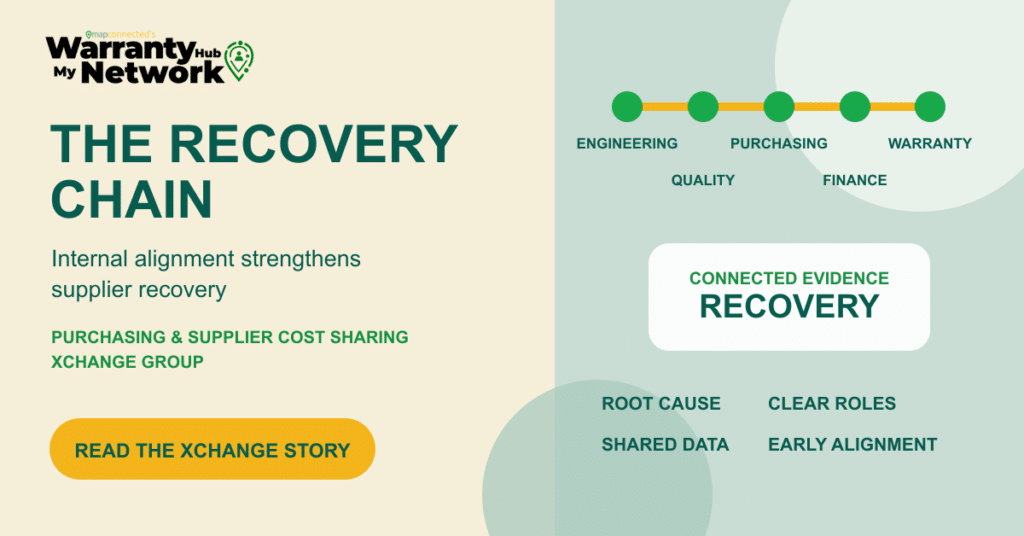
- Align objectives across engineering, quality, purchasing, finance and warranty.
- Educate stakeholders on how their decisions affect recovery.
- Connect root cause to recovery, particularly around No Trouble Found findings and parts analysis.
- Clarify roles and escalation paths to accelerate resolution.
- Use data and financial impact to show why decisions matter.
- Build recovery expectations into supplier agreements from the start.
These actions do not remove every disagreement. They create a stronger recovery chain by making ownership, evidence and consequences clearer across the organization.
From Internal Alignment to Better Outcomes
The Recovery Chain discussion reinforced that supplier cost recovery is not owned by one department. It is the result of connected technical, operational, contractual and financial decisions.
Organizations that want stronger recovery outcomes should look upstream. Are teams working from the same evidence? Are responsibilities and escalation paths clear? Do supplier agreements support the recovery model? Can the recovery team engage early enough to influence the outcome?
Supplier recovery alignment turns those questions into a shared operating discipline. It helps teams move from late-stage negotiation toward earlier coordination, clearer accountability and more defensible decisions.
The Conversation Continues At The 6th Annual Summit
The Purchasing & Supplier Cost Sharing Xchange Group will share selected best practices at the MAPconnected Service & Warranty Lifecycle Summit, October 19–21 at the Westin Southfield Detroit, followed by an extended two-hour in-person Xchange Group meeting.
Want to be part of the conversation in 2027? The Best Value 3-Day All Access Ticket Bundle includes a full year of MAPconnected membership, giving you access to the Summit plus the group’s virtual benchmarking sessions throughout 2027.
Explore MAPconnected Xchange Groups
MAPconnected Xchange Groups provide a confidential environment where industry leaders can benchmark processes, compare operational approaches, discuss challenges, and learn directly from peers facing similar issues.
Rather than presentations or vendor pitches, these sessions are built around practical conversations that help participants identify new ideas, validate strategies, and accelerate improvements within their own organizations.
Professionals interested in supplier recovery, warranty operations, quality, purchasing, and cost-sharing strategies are encouraged to join future discussions and contribute to the growing industry knowledge base.
MAPconnected Leadership Xchange Groups include:
- Technical Assistance Centers (TAC)
- Warranty Administration
- Recall, Customer Campaigns & Legal
- Parts Return & Quality Analysis
- Purchasing & Supplier Cost Sharing
- Financial Products & Insurance
- NEW! Field Services Connected Data
For more information: