

LOUISVILLE, Ky. — Ford Motor Co.’s Kentucky Truck Plant is a symphony of noise and activity. The assembly line moves through multiple levels of the facility, where robots and humans come together to assemble large components.
All of the Ford vehicles built at the plant use traditional body-on-frame construction, meaning the body is mounted atop a separate, sturdy ladder frame. This assembly method simplifies the manufacturing process, allowing Ford to more easily produce different vehicle body styles on the same chassis. So an Expedition SUV might be followed on the assembly line by a Lincoln Navigator, which is then followed by a F-250 or F-550 Super Duty pickup truck.
There’s a reason why the Kentucky facility is so noisy: Ford is one of the largest auto manufacturers and a major employer in the state; more than 9,000 employees rely on the plant for a paycheck, including 8,200 hourly workers.
Last year, the automaker invested $500 million in the plant to prepare it to build the new 2026 Expedition, which began rolling off the assembly line earlier this year.
Ford CEO Jim Farley was on hand for Job One. During his remarks at the plant, he consistently stressed Ford’s focus on quality. For the new Expedition, the company invested in more inspections, technology tests and other AI-powered inspection tools compared to the last Expedition launch.
“The process and many of the tools are entirely new,” said Brittaney Heine, team leader, Kentucky Truck Plant, during a recent media tour of the factory. Heine was positioned near the split tailgate assembly station, a new feature on the Ford Expedition and Lincoln Navigator.
Ford also added two new SUV trim lines to the factory’s 25 miles of conveyor track to accommodate the new split gate assembly, which is tested up to five times before customer delivery. Inspectors check sensors, smoothness of operation and alignment. Other new items on the quality checklist for the Expedition are the lift gate lights and seatback USB-C ports.
The unique split gate design can support up to 500 pounds and transforms the cargo area into a bench with a backrest, a shelf for tier packing, or even a serving table for meals and drinks. Power outlets in the cargo area are just an arm’s length away for added convenience. Every design aspect reflects customers’ needs, according to Ford. Its research found that families use the Expedition to the fullest for activities like camping, tailgating and kids’ sports.
Despite the focus on quality improvements, the company has been plagued by recalls this year, affecting several models built in Kentucky. Some 2025 Ford Expedition and Lincoln Navigator SUVs were recalled in June over faulty passenger side air bags, which were manufactured incorrectly by the supplier. But dealers are replacing the air bags in the SUVs free of charge under warranty.
Starting with the 2026 Expedition, Ford added 1,200 inspections, 203 new inspectors, 72 new technology tests and six times the number of AI-powered inspection tools compared to last year’s model launch.
Another nod to improving quality is Ford’s use of its Mobile Artificial Intelligence Vision System, which uses AI, machine learning and computer vision technology to help operators detect quality issues in real-time. The technology was developed by Ford and deployed at 27 plants globally, including in Kentucky.
“Team leaders can stop the [assembly] line and have operators fix any issue immediately,” said Warren McWilliams, a process engineer at the facility, who spoke during the tour about AI and 3D printing. “The technology is highly adaptable and can be moved anywhere in the plant.”
Another way we can see Ford’s push towards quality is 3D printing, which is being used to create tools to improve the accuracy and efficiency of the plant’s quality control processes, such as creating custom light fixtures or helping operators see connections more clearly.
All vehicles produced at the Kentucky Truck Plant go through the “Ford Customer Product Audit,” where inspectors conduct a static and dynamic audit using a 166-point checklist to help ensure quality of the new Expedition.
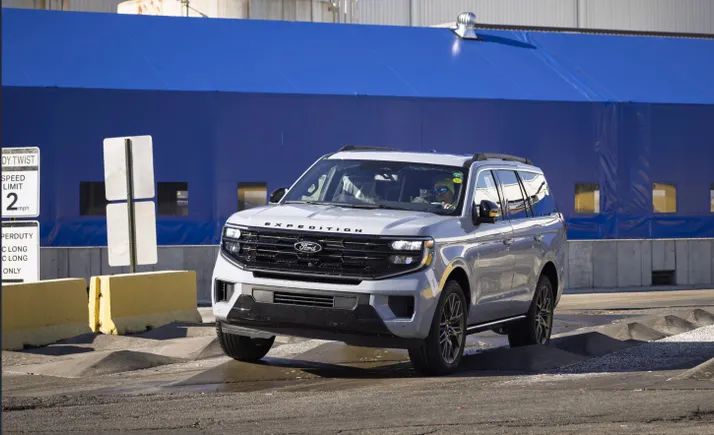
A final quality check takes place outdoors in what’s called a “squeak and rattle test.” One of 20 trained drivers takes each vehicle on a test track just outside the plant that simulates various road surfaces. The employee listens for any unwanted noises and notes them on a checklist, so Ford engineers can later pull the vehicle and inspect it further.
The factory road test is especially important because Ford refined the driving experience of the 2025 Expedition model based on feedback from nearly 500,000 customer test drives.
The goal is to balance a smooth ride over uneven surfaces with the highway ride that customers love — the best of both worlds for a driver.
It’s the level of no-compromises quality that customers expect.