

OEM peers are moving beyond attach rates and portfolio results to examine the choices underneath them: risk ownership, governance, product mix, stakeholder alignment and how value is measured across the lifecycle.
Financial Products & Insurance Benchmarking must look beyond attach rates and portfolio results to examine the structural decisions that shape program performance, dealer confidence, customer value and lifecycle profitability.
Attach rate is easy to put on a slide.
It is much harder to explain why one program earns dealer confidence, delivers long-term customer value and produces sustainable profitability while another struggles to move.
That is the work now taking shape inside the MAPconnected Financial Products & Insurance Xchange Group.
The group brings together leaders from AGCO, Cummins, Gibson, Mitsubishi Logisnext, Polaris, Rotobec and other participating organizations. Their discussion has moved from individual performance measures toward the structure underneath them.
What Financial Products & Insurance Benchmarking Reveals
The work has examined how financial-product and insurance programs are designed:
Who owns the risk?
Which obligor model is in place?
Where do third-party administrators and insurers sit?
How are decisions governed across functions?
What does the structure mean for dealers and customers?
Those choices are not administrative details. They shape claim control, dealer trust, customer experience, capital requirements and the organization’s ability to see true program performance.
Performance is not one number
The group’s next layer of benchmarking considers attach rates, portfolio mix, margin and lifecycle profitability.
The purpose is not to chase a universal target. Different brands, channels, products and risk structures will produce different results. The more useful question is whether each organization can explain what drives its performance and whether the program is aligned with the outcome it wants.
That includes examining:
Attach and penetration rates by product and channel
Portfolio mix and product positioning
Margin and lifecycle profitability
Alignment between risk models and financial outcomes
The value delivered to customers, dealers and the organization over time
From discussion to a maturity framework
With input from Jimmy Bynum of Garde Solutions, the group worked on a structured maturity assessment to help participants compare program design and performance without crossing confidentiality lines.
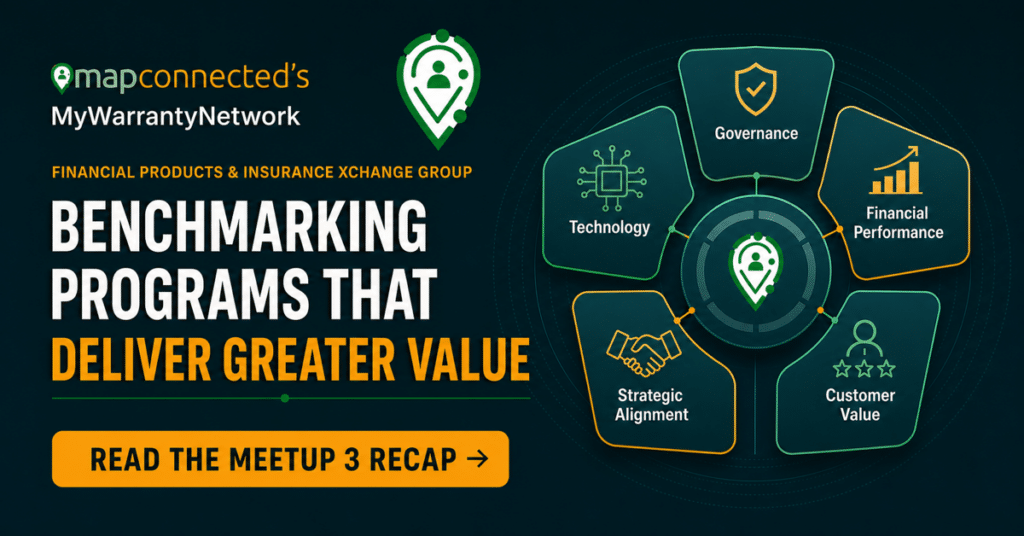
The assessment was intended to establish a baseline, identify strengths and gaps, and support anonymized peer benchmarking across areas such as governance, technology, financial performance and strategic alignment.
The work creates a bridge to the October 19 Summit workshop, where additional participants can examine their own warranty and service-contract maturity in a guided setting.
Turning Benchmarking Into Practical Improvement
Financial Products & Insurance Benchmarking becomes more useful when participants can connect performance results to the decisions that produced them.
For one organization, that may mean examining why product penetration differs across channels. For another, it may involve reviewing whether its current risk or obligor model supports the intended dealer and customer experience. Other organizations may need stronger alignment between warranty, finance, insurance, dealer operations and executive leadership.
A useful benchmark does not assume that every organization should operate in the same way. Different products, markets, distribution models and customer expectations will naturally produce different structures and results.
The objective is to help participating leaders understand the choices behind their performance, compare relevant approaches with peers and identify areas that deserve further investigation. This creates a stronger foundation for internal decision-making and practical improvement.
As the maturity framework develops, Financial Products & Insurance Benchmarking will continue connecting peer insight with measurable program dimensions.
More OEM voices are welcome
The value of a benchmark improves when the room contains different product categories, channels and operating models.
OEM leaders responsible for financial products, insurance, service contracts, warranty strategy, risk or program performance can inquire about joining the group and contributing to the next stage of the work.
If this is something of interest – join us for the 3-hour workshop on October 19th at the Service & Warranty Lifecycle Summit. Participants will build and assess a fictional OEM or dealer organization using real-world experience, identifying capability gaps across seven key dimensions and leave with actionable recommendations and a practical framework they can apply within their own organizations.