

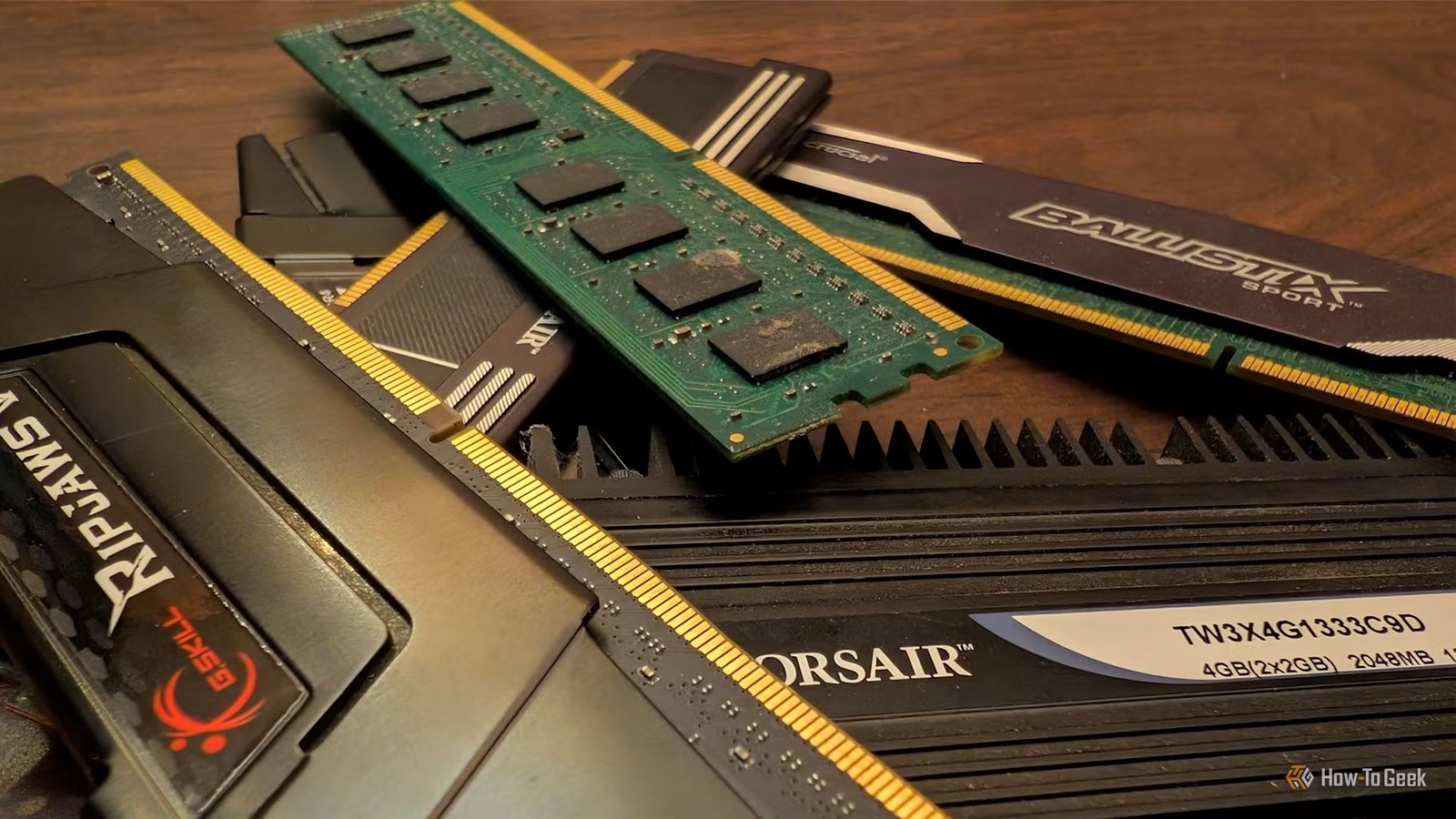
Got any broken RAM sticks in your drawer? Perhaps your RAM stopped working right smack in the middle of the RAM-pocalypse? Worry not, because many memory vendors offer lifetime warranties on their products.

HTG Wrapped 2025: 24 days of tech
24 days of our favorite hardware, gadgets, and tech
Those Lifetime RAM warranties are legit

You might have heard about RAM having a lifetime warranty and thought it sounds too good to be true. But it turns out those lifetime warranty practices are legit, kind of.
The main reasons RAM is the only PC component that commonly comes with a lifetime warranty are that the DRAM chips used in RAM sticks have no moving parts, generate little heat during operation, and run at a constant, low voltage (unless you overclock).
Oh, also, DRAM cells have about 10 billion times the endurance of NAND cells used in SSDs. In other words, unless a stick of RAM is defective from the get-go, chances are it will work for decades. This is why buying second-hand RAM isn’t a bad idea, especially now in the middle of the RAM-pocalypse.
Lifetime RAM warranties do come with a number of limitations—they are called limited lifetime warranties, after all. With that said, if you’ve got a couple of broken RAM sticks, there’s a good chance you can get a replacement or at least some of the money you spent on them back.
Now, as I’ve said, a lifetime RAM warranty isn’t lifetime in the sense of the buyer’s lifetime. It covers the product’s lifetime, i.e., how long it should reasonably last. For instance, Kingston defines product lifetime as “the normal time expectancy for the use of products in the industry.”
Of course, the manufacturer has the last say on how long RAM should reasonably last, but if you didn’t break it by overclocking, and if the sticks and chips below the heatsinks show no physical damage, you should be eligible for a replacement or a refund.

You may apply for warranty even a decade after you bought the memory, it’s just that you probably won’t get a replacement that matches the original product’s specs. In most cases, you might get a full or partial refund, a replacement the manufacturer considers equivalent or comparable to the RAM you bought, or in-store credit if the vendor has an online storefront.
Don’t get your hopes up for a refund that reflects the current market value of the memory. In these situations, the refund matches the original purchase price or fair market value, whichever is lower.
Aside from the sticks being free of any physical damage, you also must be the original purchaser (the warranty is void for second-hand memory). In some cases, you may also need proof of purchase. If you don’t have any proof of purchase, a good portion of manufacturers count the start of the warranty period from the date of manufacture (they can easily verify this by looking at the serial number), but some may ask for it.
Note that a lifetime warranty may not apply in some countries that consider it a fixed term, or have laws that do not recognize a lifetime warranty. Some manufacturers include those terms in their warranty policies.
For instance, TEAMGROUP states that the company’s “lifetime warranty might not apply to customers in certain countries or states due to conflict of laws, but this limited lifetime warranty does not affect customers right to enjoy the longest warranty period allowed by law in those areas.”
While it offers lifetime warranty for its memory, Crucial does state that “Limited lifetime warranty is limited to 10 years from purchase in Austria, Belgium, France and Germany.” If your country considers lifetime warranty a fixed term, you might be out of luck. That said, Micron, the company that owns the brand, recently shut it down, so I’m not sure what the current situation with Crucial’s memory warranty is.
Here’s what to expect from the RMA process

After you decide you’d like to exercise your rights as a customer, you should see if the manufacturer of the memory in question offers a lifetime warranty in the first place. Most RAM brands do, but it’s better to be safe than sorry. Regarding the popular memory brands, G.SKILL, TEAMGROUP, Corsair, Patriot, and Kingston all offer limited lifetime warranty on their RAM.
Once you’re sure the manufacturer offers a lifetime warranty, I recommend inspecting the sticks for signs of physical damage. If they look fine, try finding proof of purchase. Not all vendors require one, but it’s better to have one just in case.
The next step is to go to the manufacturer’s website and find the online RAM request form. You should Google this easily. If you can’t find it, look up their customer service or technical support emails; every RAM manufacturer should have at least a few.
Before you embark on this adventure, you should know that there’s a good chance you’ll need to send the RAM to the company’s regional headquarters and pay for shipping. Those living in the US can call upon the Magnuson-Moss Warranty Act of 1975 to try to avoid paying for shipping. If you’re outside the US, you should research your options in case you’re asked to foot the shipping bill.
You should also be ready for a few days of back-and-forth communication with the company’s reps to get an RMA authorization. Once you’ve been approved and shipped the memory, you’ll have to wait for the company to process the RMA after it receives the RAM, which can take a few weeks.
I recommend asking the rep how long it usually takes to process the RMA and to email them as soon as that period ends. Once the company processes the RMA, it should notify you and present you with the options (a full or partial refund, in-store credit, or replacing your RAM with the same or equivalent memory).
If you have any broken RAM sticks, it costs you nothing to try to take advantage of their warranty. The worst that can happen is having your request denied, but if you manage to get a refund—or, even better, a replacement—it can be well worth your time.

It’s a bad time to build a PC—but tomorrow will be worse
The PC building storm is brewing, and waiting it out may cost you more in the long run.