

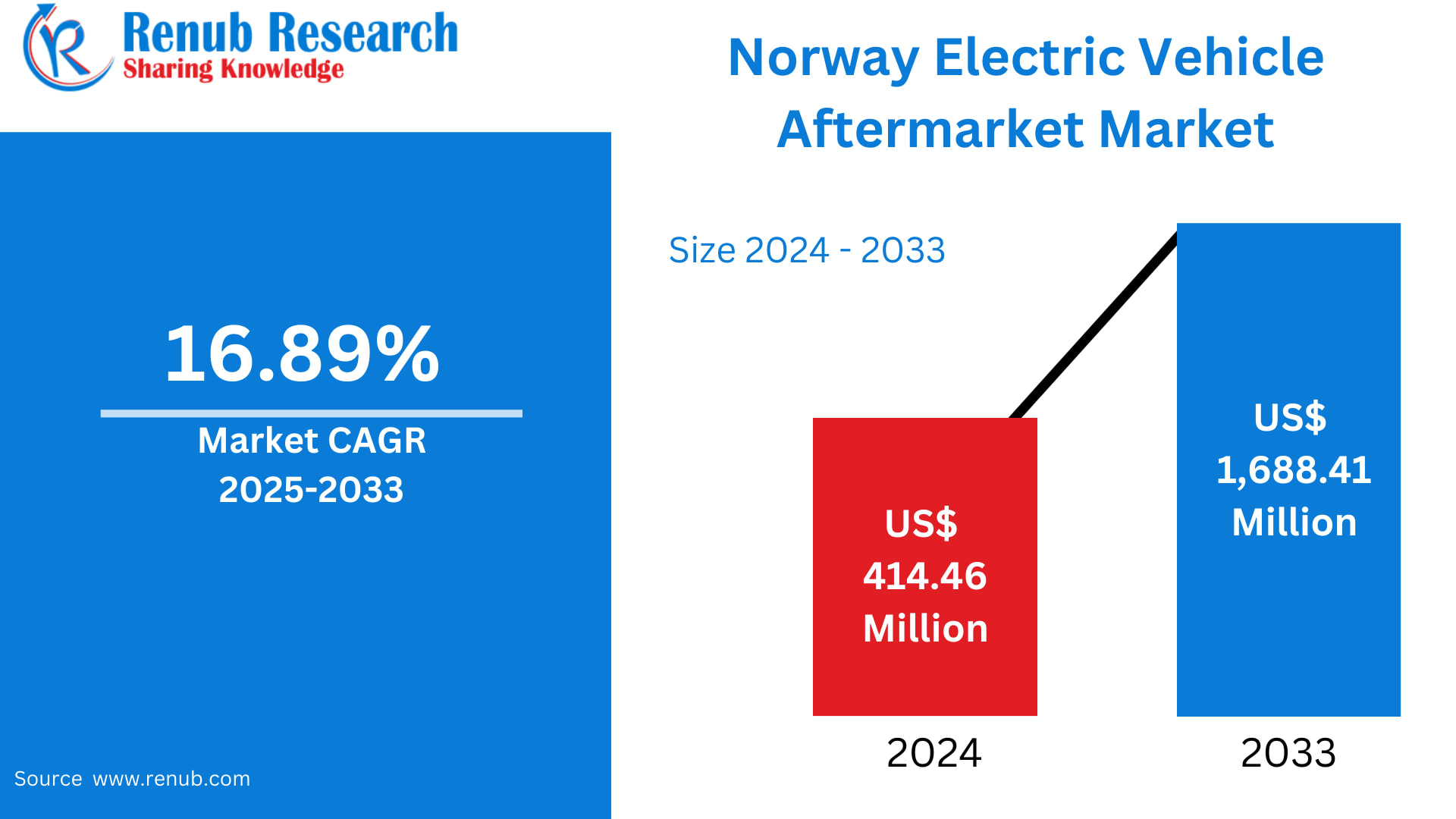
The Norway Electric Vehicle Aftermarket Market is on a rapid upward trajectory, projected to reach US$ 1,688.41 million by 2033, rising sharply from US$ 414.46 million in 2024. According to Renub Research, the market will record an impressive CAGR of 16.89% from 2025 to 2033, fueled by the country’s unparalleled EV adoption, robust sustainability goals, increasing demand for battery upgrades, expansion of charging networks, and a rising volume of used EVs entering the marketplace.
As the world’s most advanced EV ecosystem, Norway has become the benchmark for how market maturity, policy support, and consumer preference can transform not just vehicle adoption but the entire value chain surrounding it—including the rapidly growing EV aftermarket.
Understanding the Norway EV Aftermarket
The electric vehicle aftermarket comprises products, services, and solutions associated with a vehicle after it is purchased. Unlike conventional automobiles, EVs rely heavily on digital systems, high-capacity batteries, and advanced electronics. This creates evolving aftermarket needs centered around:
Battery repairs, refurbishments, upgrades, and replacements
Software updates and diagnostics
Tires, brakes, and body parts
Charging equipment and smart-charging solutions
Second-life battery applications
Energy management tools and accessories
As Norway’s EV fleet continues aging—and ballooning—the aftermarket has become a critical pillar of the nation’s mobility ecosystem.
Why the Norway EV Aftermarket Is Growing So Rapidly
1. Norway’s High EV Adoption Rate
Norway is the undisputed global leader in electric mobility. In recent years, EVs have accounted for the majority of new car sales, thanks to generous incentives such as:
Exemption from VAT
Free or reduced road tolls
Lower registration taxes
Preferential access to bus lanes
Extensive charging benefits
This has led to a massive and aging EV fleet requiring:
Routine maintenance
Battery replacements
Diagnostic services
Software optimizations
Spare parts for electronics and high-usage components
As more EVs shift into the used-car market, the demand for affordable aftermarket solutions is accelerating.
Norway’s continued emphasis on zero-emission mobility ensures aftermarket demand will remain strong through 2033.
2. Expanding Charging Infrastructure fuels aftermarket services
Norway boasts Europe’s most mature charging infrastructure—with both fast-charging corridors and densely packed urban charging points. This has several aftermarket implications:
Higher EV usage leads to increased wear on batteries, tires, and brakes
Smart charging solutions—such as V2G (Vehicle-to-Grid) and home energy management—create demand for installation and maintenance services
More charging hardware translates into ongoing replacement, repair, and upgrade requirements
Norway’s commitment to universal charging accessibility strengthens the entire aftermarket ecosystem, from charging equipment sales to servicing and upgrades.
3. Strong Sustainability Goals Driving Market Expansion
Norway aims to phase out all internal combustion engine (ICE) vehicle sales by 2025, a target unmatched globally.
This aggressive push toward climate neutrality is amplifying aftermarket demand across multiple categories:
Refurbished battery packs
Recycled auto parts
Second-life battery energy storage solutions
Green repair practices and eco-friendly workshops
Norwegian consumers prefer sustainable solutions, creating a significant pull for greener aftermarket services. For companies offering circular-economy products, Norway is an ideal testing ground.
Key Challenges Hindering Market Growth
Despite fast growth, Norway’s EV aftermarket faces constraints that industry stakeholders must address.
1. High Dependence on Imports
Norway has minimal domestic automotive manufacturing. As a result:
Most EV spare parts—especially batteries, semiconductors, and electronic components—must be imported.
Supply chain fluctuations, geopolitical tensions, and global shortages can trigger high costs and long delivery periods.
Exchange-rate volatility impacts pricing for service providers and consumers.
As EV adoption surges, import reliance may restrict affordability and availability, particularly for critical components such as high-voltage battery modules.
2. High Investment Requirements
Setting up advanced aftermarket infrastructure requires substantial capital, especially for:
Battery diagnostics and refurbishing equipment
High-voltage safety training for technicians
Specialized workshops
Advanced recycling and disposal facilities
Battery recycling remains a major challenge. End-of-life lithium-ion batteries are rising sharply, but recycling facilities are limited and costly. Strict EU and Norwegian regulations require environmentally safe handling, adding to compliance pressure.
Without a more robust recycling and refurbishing ecosystem, Norway may struggle to manage used batteries sustainably—potentially pushing up service and replacement costs.
Regional Market Insights
Norway’s EV aftermarket is geographically diverse, influenced by region-specific EV adoption patterns, charging infrastructure, climate, and commuting behavior.
Oslo Electric Vehicle Aftermarket
As the capital and Norway’s most densely populated city, Oslo is the heart of EV adoption and aftermarket services.
Key Drivers in Oslo
Highest EV penetration in the country
Dense urban charging network
Strong sustainability initiatives
Concentration of dealerships, workshops, and tech companies
The demand is highest for:
Battery replacements
Charging equipment upgrades
Routine maintenance
Software and diagnostic services
Challenges: High service costs, workshop congestion, and dependence on imported electronic components.
Viken Electric Vehicle Aftermarket
Viken is Norway’s most populous county and a commuter-heavy region.
Key Drivers in Viken
Large EV fleet fueled by daily commuting
Strong demand for battery servicing and replacement parts
Growth in used EV ownership requiring cost-effective repairs
Its proximity to Oslo gives Viken access to advanced suppliers, but rural areas still face service coverage gaps and a shortage of EV-trained technicians.
Vestland Electric Vehicle Aftermarket
Vestland combines urban hubs like Bergen with challenging mountainous terrain.
Key Drivers
Expanding public and private charging infrastructure
High EV ownership supported by local incentives
Harsh weather increasing wear on EV components
Strong sustainability push for battery recycling and green repairs
Challenges: High logistics costs and limited workshop availability in remote areas.
Rogaland Electric Vehicle Aftermarket
Home to Stavanger, Norway’s energy capital, Rogaland is an emerging EV aftermarket hotspot.
Key Drivers
Strong charging infrastructure
Innovation driven by the region’s energy and tech ecosystem
High commuting traffic increasing the need for maintenance
Rogaland is also a center for smart charging, energy storage integration, and EV–grid innovation.
Challenges: Limited local spare-parts inventory and shortage of specialized EV technicians.
Market Segmentation
By Type
Tires
Battery
Brake Parts
Filters
Body Parts
Lighting & Electronic Components
Wheels
Others
EVs consume tires faster due to higher torque, while batteries and electronic components dominate revenue share.
By Vehicle Form
Passenger Cars
Commercial Vehicles
Passenger cars account for the majority of demand due to Norway’s high private EV ownership, but commercial EVs—delivery vans, taxis, logistics vehicles—are rising rapidly.
By Distribution Channel
Authorized Service Centers (OEMs)
Premium Multi-Brand Service Centers
Digital Aggregators
Others
Digital aggregators are growing as tech-savvy Norwegian consumers prefer transparent pricing, online bookings, and mobile maintenance.
By States
Oslo
Viken
Vestland
Rogaland
Trøndelag
Vestfold og Telemark
Innlandet
Agder
Møre og Romsdal
Troms og Finnmark
Each region contributes uniquely, shaped by local EV density, charging availability, climate, and workforce skill levels.
Key Players in the Norway EV Aftermarket
Companies dominating the market include:
3M
ABB Ltd.
EVBox Group
ChargePoint Inc.
Webasto SE
Siemens AG
Bosch Automotive Service Solutions Inc.
Schneider Electric SE
These companies are expanding their footprint through innovations in charging, diagnostics, battery management, and energy solutions.
Final Thoughts
Norway’s Electric Vehicle Aftermarket Market is positioned for exceptional growth through 2033. With the EV revolution already mainstream in the country, aftermarket services—ranging from battery replacements to smart-charging installations—have become essential to keeping the mobility ecosystem functioning.
Challenges such as import dependence, high investment requirements, and limited recycling capacity still pose obstacles. But as technology evolves and the EV fleet expands, the aftermarket sector is expected to play a front-and-center role in Norway’s long-term climate, mobility, and sustainability goals.
Driven by innovation, consumer demand, and forward-thinking government policies, Norway stands as a model for how nations can build a resilient, scalable, and profitable electric vehicle aftermarket economy.