

Turning warranty data into faster action, connected intelligence and better customer outcomes
Warranty has never been just about processing claims.
For aftersales leaders, the information inside those claims can reveal product issues, dealer performance, technician challenges, supplier problems and opportunities to improve the customer experience. The challenge is getting that information to the right people quickly enough to do something about it.
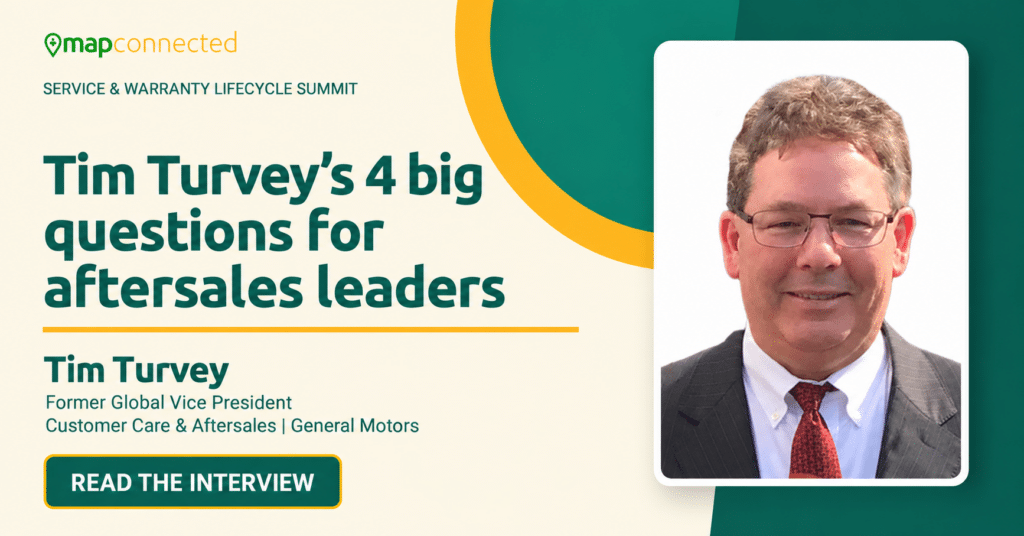
That is the thread running through a conversation with Tim Turvey, former Global Vice President of Customer Care & Aftersales at General Motors, who brings decades of experience inside the OEM environment to key questions facing warranty and aftersales leaders today.
His perspective is both forward-looking and practical: connected vehicles, guided diagnostics, telematics and AI can fundamentally change how the industry identifies and responds to problems. But technology alone won’t solve the underlying challenges. Leaders still have to decide where to invest, how to connect fragmented information and, ultimately, whether those investments improve outcomes for the customer.
At the center of the interview with Pam Walter are four questions every aftersales leader should be asking.
1.How fast does your warranty data move?
A vehicle assembly plant running at 60 vehicles an hour across two eight-hour shifts can build 960 vehicles a day. For Tim Turvey, that makes the time between identifying a problem and implementing a remedy a measure of exposure: Another day can mean almost 1,000 more vehicles with a potential issue.
For Turvey, one of the biggest opportunities in warranty is straightforward: identify issues sooner, get accurate information to decision-makers faster, and reduce exposure.
A claim may be processed correctly while the information behind it reaches engineering or quality too late to prevent more vehicles from being affected. Turvey’s priority is to get accurate data into the organization quickly enough to identify the problem, understand it and act. Rapid claim submission becomes an important part of the equation.
Dealers have a direct role. He describes claims sitting for weeks before submission, delaying the opportunity for OEMs to analyze them. Faster submission supports dealer cash flow, but it also gives manufacturers earlier access to evidence from the field.
There is a financial tension here. Warranty represents a substantial commitment for the OEM, while dealers need accurate reimbursement. Turvey argues for looking beyond that transaction to the value of finding and resolving the issue sooner.
For a leadership team, the useful measure is therefore not only how quickly a claim is paid. It is how quickly the information can influence a decision.
Essentially, faster information, better identification, earlier action, less exposure!
2. What would change if the entire service ecosystem were connected?
Turvey’s most compelling vision is a connected service ecosystem in which information doesn’t stop at the point where a repair is completed. Describing service process in which the vehicle, diagnostic tools, technician, warranty system, supplier and engineering team exchange information throughout the repair.
Imagine the process:
Vehicle Issue → Telematics Identification → Customer appointment → Guided diagnostics → Technician actions → Labor and failure codes → Warranty claim → Supplier notification → Engineering feedback → Corrective action
The appointment leads into serving up a guided diagnostics route for technician to follow. The technician’s work from guided diagnostics informs the labor and failure codes for warranty claim which can be automatically submitted in real time. Warranty System informs Brand Quality and OE Engineering about the customer complaint, causal issue and remedy. AI helps sort and group, so most critical issues are brought forward in rapid fashion.
The value is a faster feedback loop, with evidence moving beyond the completed repair to the teams able to investigate and respond: a continuous feedback loop.
That vision also addresses practical constraints: increasingly complex vehicles, technician shortages and difficulty finding experienced warranty personnel. Guided diagnostics and repair can help people work through complex tasks without depending entirely on years of individual experience.
Telematics contributes to this picture, but Turvey distinguishes detecting a fault from understanding it. A fault signal does not necessarily explain the cause or identify the remedy. It has to work alongside diagnostic evidence, warranty information and the people interpreting them and the value comes from connecting that information with the other data and processes needed to determine what happens next.
3. Is AI solving the problem, or just adding another layer of technology?
Turvey sees potential for AI to identify relationships across vehicle platforms, engine families, suppliers and plants, helping teams investigate issues and develop remedies sooner. But he is equally clear about what AI cannot do.
AI is not the fix-all.
The constraint is familiar to OEM leaders: demand for systems and software exceeds the available people, time and capital. Choosing where to invest requires a clear objective. Is the priority product quality, customer satisfaction or profitability? Those outcomes can reinforce one another, but they are not interchangeable.
His experience with warranty technology illustrates why this matters:
Large-scale warranty systems require extensive integration: vehicle build data, labor codes, dealer rates, claim rules, mileage, overlaps, comebacks, analytics and numerous other relationships. Turvey describes the complexity and investment involved in maintaining these systems, as well as the difficulty of replacing them once they become deeply embedded in an organization.
Turvey raises a further question: should manufacturers keep funding separate systems for work that is not necessarily a source of competitive differentiation?
That raises a larger industry question:
How much of the industry’s technology investment is being duplicated because organizations are solving similar problems separately?
He proposes considering a shared global warranty platform, with each manufacturer’s data appropriately separated and protected. Dealer groups could also benefit from fewer systems and processes to navigate.
The investment question extends beyond what AI can do. Leaders must decide which problems merit their resources and where collaboration could reduce duplicated effort.
4. Are we improving the customer experience, or just improving the process?
“Don’t lose sight of the fundamentals. And don’t chase the shiny object.”
Turvey’s closing advice returns to the fundamentals: do not chase technology at the expense of the customer.
Faster claims, guided diagnostics and better analytics need to improve what happens to the person relying on the vehicle. Repeat purchases and repeat service depend on that experience, not on the sophistication of the systems behind it.
The responsibility is shared. Dealers can submit claims sooner. Suppliers can be more open about problems and work with OEMs on continuous improvement. Leadership teams can judge technology proposals against the outcome they are trying to improve, rather than the appeal of the technology itself.
Turvey’s four questions point toward a broader shift in how the industry can think about warranty and aftersales.
How fast does information move?
How connected is the ecosystem?
Where does technology actually create value?
And are the decisions ultimately improving the customer outcome?
Continue the conversation
Tim Turvey will bring these perspectives to the MAPconnected Service & Warranty Lifecycle Summit, October 19–21, 2026, at The Westin Southfield Detroit.
The conversation continues with OEM, supplier, dealer and technology leaders examining how warranty, quality, service, connected data and AI are changing the service and warranty lifecycle.
Designed By Warranty Leaders For Warranty Leaders.
Bring your toughest questions. Join the conversation.
