

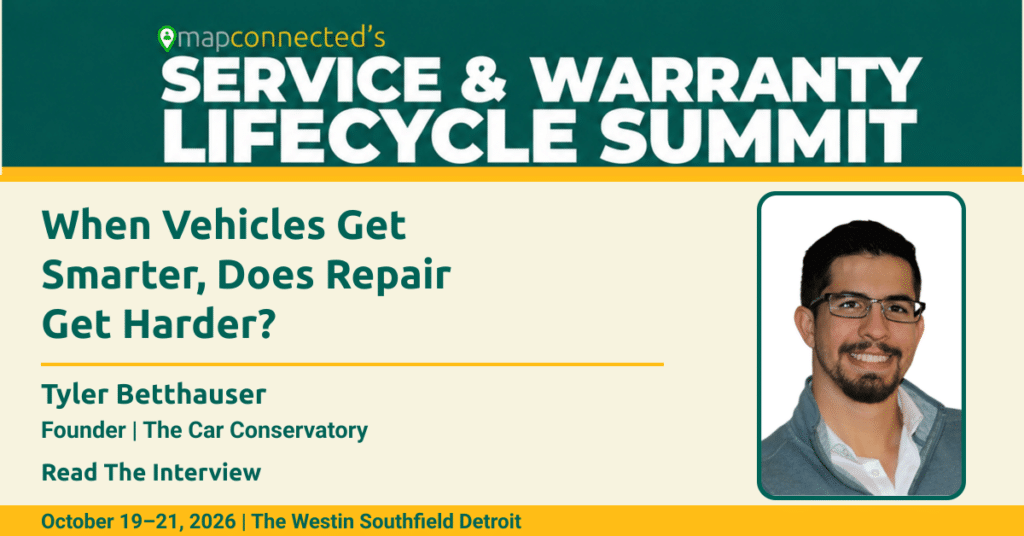
Tyler Betthauser believes the industry’s next serviceability challenge starts long before a vehicle reaches the service bay.
Vehicle serviceability is becoming more important as vehicles grow more connected, software-defined and complex.
On an engineering bench, connectors may be exposed and software logs readily available. Inside a vehicle, a technician investigating the same system can face restricted access, limited information and a running clock.
Tyler Betthauser has worked on both sides of that divide. His career includes OEM software engineering, EV field monitoring, service manual and labor-time validation, and direct work with technicians.
Today, as Founder of The Car Conservatory, he brings that experience into independent repair serving the Metro Detroit area. The Car Conservatory is building a different model for automotive repair, combining engineering-led diagnostics, advanced repair capabilities and a concierge service experience. The focus is on finding and addressing the root cause of a problem rather than defaulting to parts replacement, while making the repair process more transparent, precise and less disruptive for the vehicle owner.
In his conversation with MAPconnected’s Pam Walter, Tyler explores what happens when increasingly sophisticated vehicles meet a repair environment facing technician shortages, rising costs and difficult diagnostics.
His central argument: serviceability needs to influence how vehicles are designed, not become a problem for the service team to solve afterward.
1. Are We Designing Vehicles For The Repair Environment?
Tyler remembers a poster from his time in customer care and aftersales: design with service in mind. He found that thinking less obvious when he moved into software and electrical engineering.
Understanding a system in a laboratory is different from diagnosing it inside a customer’s vehicle. Working alongside technicians showed him how access, available information and time pressure affect the investigation.
His concern is when those realities enter vehicle development. By pre-production, broad changes to improve diagnosis can be difficult. Serviceability needs a place in the requirements set by senior architects and engineering leaders, while design choices are still being made.
Early workshop experience helps, but Tyler does not see it as a one-time exercise. Vehicles and repair conditions change. He argues for continuing contact between engineering and service, supported by development checkpoints where decision-makers act on feedback from the field.
2. What Happens When The Technician Shortage Meets The Software-Defined Vehicle?
For Tyler, the workforce challenge is not simply how many technicians are available. It is whether they have the information, tools and training to repair increasingly complex vehicles.
A technician needs to distinguish a software issue from a hardware failure before deciding what to repair or replace. When a system reveals too little information, the investigation becomes harder, regardless of how sophisticated the vehicle itself may be.
Compensation matters too. Difficult diagnostic work takes time. Tyler describes The Car Conservatory’s approach as separating technician pay from sales and basing repair orders on diagnostic time rather than part swapping.
The aim is to support careful investigation without leaving technicians worried about being paid for taking on a difficult problem. Better tools alone cannot resolve an incentive structure that rewards replacement more readily than diagnosis.
3. What Are “No Trouble Found” And Comebacks Telling Us?
During his OEM career, Tyler investigated returned parts whose test results could not explain the customer’s symptoms. From the repair side, he sees the related problem: a component has been replaced, but the customer’s concern remains.
Those outcomes raise questions about more than the part. Was the technician able to access the right information? Could the fault be isolated? What did the investigation reveal that engineering needs to understand?
Tyler wants those lessons to influence vehicle development. Collecting more repair data is not enough if the people making design decisions remain disconnected from what technicians encounter.
The practical test is whether experience from a difficult repair changes how the next vehicle can be diagnosed and serviced. For the customer, what matters is whether the problem is resolved, not simply whether a replacement appears on the repair order.
4. Can Connected Data Move Repair From Reactive To Proactive?
Tyler’s EV field-monitoring work used vehicle data to identify emerging battery risks and support intervention. He sees an opportunity to connect early detection with practical help for the owner.
He describes a concept called “active telemetric protection”: monitor vehicle data for warning signs, then help the customer arrange and complete the necessary service.
The ambition goes beyond sending an alert. Instead of leaving an owner to interpret a message and work out what to do next, the service response would connect the warning with diagnosis, scheduling and repair.
For aftersales leaders, that raises an important question: what happens after the signal appears? Detecting a potential problem creates value when the organization can turn that information into timely, effective support.
Continue The Conversation In Detroit
Tyler’s perspective connects decisions made during vehicle development with the experience of the technician and customer years later. Are we designing vehicles that can be understood, diagnosed and repaired and supporting the people expected to do that work?
Tyler Betthauser, Founder of The Car Conservatory, will explore these issues in “When ‘No Trouble Found’ Isn’t No Trouble: Rethinking Diagnosis, Technician Pay & Repair Quality” at the 2026 MAPconnected Service & Warranty Lifecycle Summit, October 19–21 at The Westin Southfield Detroit.
Join the discussion to compare how your organization connects vehicle design, diagnostic work and repair quality.
