
A customer waiting for a repair is unlikely to care where the manufacturer’s responsibility ends and the dealer’s begins. They want their vehicle back, and to know that the people looking after it are working together. Marijo Prodanic believes warranty can help those people understand each other better.
The Director Warranty Ops & Tech Assistance at Kia America has been exploring that relationship in ongoing conversations with MAPconnected. His perspective takes us from the information inside a warranty claim to the trust between a manufacturer and its dealers, and the tools a technician needs to get the repair right.
The Customer Behind The Claim
Through the warranty work it pays for, a manufacturer is a major customer of its own dealer network. That gives it a view into the service operation that extends beyond checking whether a claim is accurate.
“What I see in warranty happens in retail,” Prodanic explains.
The same people process both kinds of repair orders. Understanding how warranty work moves through the workshop can therefore help leaders see where customers experience delays and where a process or tool could make the operation work better.
Instead of only asking whether a claim meets the rules, the manufacturer can ask what is making the repair difficult. Does the technician have the information they need? Is a recurring problem pointing to a process that needs attention? What support would help the dealership?
A Shared Interest In Getting It Right
Both manufacturer and dealer benefit when a customer is happy with the service and wants to stay with the brand. Prodanic sees an opportunity to use the evidence they already hold to work more cooperatively, supporting profitability on both sides.
“We’re not enemies, we’re partners,” he says.
That requires trust in both directions. The manufacturer needs confidence in the work carried out; the dealer needs confidence that the manufacturer understands the realities of the workshop.
It also means looking at how targets affect behavior. Vehicle sales, parts sales and labor sales may each have their own priorities, but the customer experiences the combined result. Prodanic asks whether measures across dealerships and OEMs are helping people work toward the same goal.
Making The Technology Easier To Use
Cooperation has to reach the technician, too. Prodanic describes meeting technicians who are confident repairing an engine or transmission but reluctant when the work involves IT. More complex vehicles make the usability of their support tools increasingly important.
“The fewer clicks, the better,” he says.
An intuitive tool encourages someone to engage with the technology. An over-engineered one adds another barrier. Making information available is not enough if the person diagnosing the vehicle struggles to use it.
Marijo compares using a diagnostic tool with ordering something online. A shopper can place an order in a few clicks. How many does it take a technician to reach the information needed for a repair? An OEM could sit beside a dealer technician and watch where the search slows down. If the technician knows what to look for but has to open five screens to find it, the tool is what needs attention. Making that path shorter gives the technician time back on the repair and gives the customer one less reason to wait.
Keeping The Conversation Going
Returning to these questions with Marijo lets MAPconnected follow the connections between warranty information, dealer relationships and the repair itself. That ongoing engagement gives the community access to perspectives beyond its own day-to-day responsibilities, throughout the year. For warranty and technical-support leaders, it is a chance to consider how decisions about claims, targets and technology are experienced elsewhere in the business.
Watch Marijo Prodanic’s MAPconnected interviews to explore these ideas further. Recorded separately, the two conversations offer complementary perspectives on the relationship behind the repair.
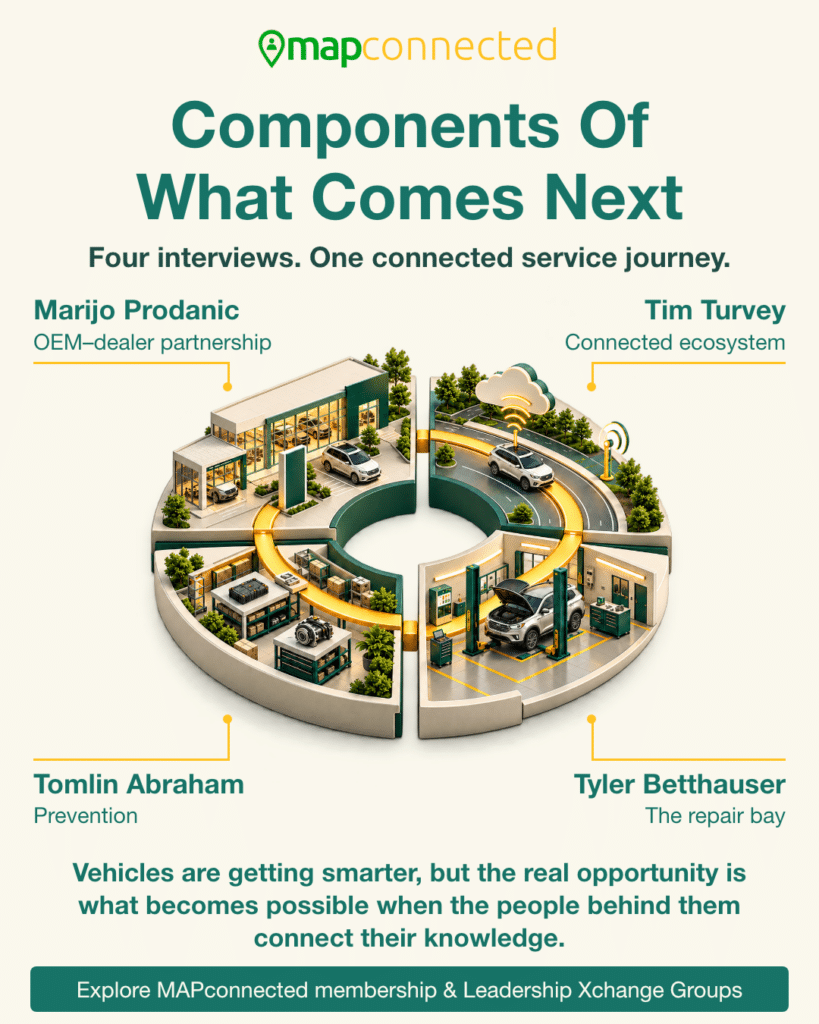
This is the opening story in Components Of What Comes Next, our four-part interview series.
Vehicles are getting smarter, but the real opportunity is what becomes possible when the people behind them connect their knowledge.
If these are challenges your team is working through, join the conversation. Explore MAPconnected membership and its Leadership Xchange Groups to exchange experience with industry peers throughout the year. Ask about membership through the contact form below.
Ask About MAPconnected Membership