

A supplier can reimburse an automaker for a failed part without changing what happens to the next customer who gets one. For Tomlin Abraham, Assistant Director Warranty Performance at General Motors, that’s where the more important warranty question begins.
In his interview with Pam Walter ahead of MAPconnected’s 2026 Service & Warranty Lifecycle Summit, Abraham asked, “how do we eliminate the spend altogether?” His point was that evidence from one repair should reach the people who can prevent the next failure.
A Career That Came Full Circle
Abraham studied mechanical engineering and served as an Army officer before joining industry. At GM, his work took him from advanced engineering and electric motors to purchasing battery cells and packs. Early in his career, he was on the engineering team trying to solve a major design problem. Today, he sees what comes back from the field and knows how far upstream the answer may lie.
What Happens After The Cost Is Recovered?
Supplier cost recovery gives both sides a financial reason to examine responsibility and commit resources. Abraham values that accountability, but the larger objective is a product that performs better in the marketplace.
Recovery answers one question: who pays for this repair? It doesn’t answer the next one: does the part need a design change, does a process need to change, or does someone need to commit resources to investigate? That’s where Abraham wants the warranty evidence to go next.
Help Suppliers Work With The Evidence
GM’s Supplier Education Day is a concrete example of the collaboration Abraham describes. Suppliers learn about warranty, engineering and purchasing systems so they can navigate the information and engage with the right people.
“We want them to look at those claims, understand trends, and raise the flag when they see opportunities to resolve or correct or create design solutions, right?” Abraham says.
A supplier looking at claims for its own part can ask a different question from the one on the invoice: are we seeing the same failure more than once? If so, Abraham wants the supplier to know whom to contact at GM and to bring a possible fix into that conversation. That gives the people who can change the part a chance to act on what the repair teams are seeing.
Education needs repeating as people change roles and different representatives join. Knowledge shared with one group cannot be assumed to have reached everyone who needs it later.
Connect The Systems In Manageable Pieces
Abraham sees another obstacle in systems developed around the separate needs of finance, engineering, purchasing, manufacturing and quality. Each had a job to do. They were not all built to exchange information in the ways people now want.
His suggested approach is to hold a vehicle-wide ambition while starting with particular parts or systems. Learn from those smaller pieces, then use the experience to expand. A simple component may require a different approach from a battery or propulsion system.
For Abraham, the reason to start small is to learn what might give a team earlier warning of a failure. Information that explains why a part came back is useful. The next question is whether any of it could have helped the team recognize the problem before the part failed. That is what he wants to learn before applying the same approach across a vehicle.
Abraham sees room for manufacturers and suppliers to learn from one another, though questions about liability and what information they can share remain open.
Keeping The Conversation Going
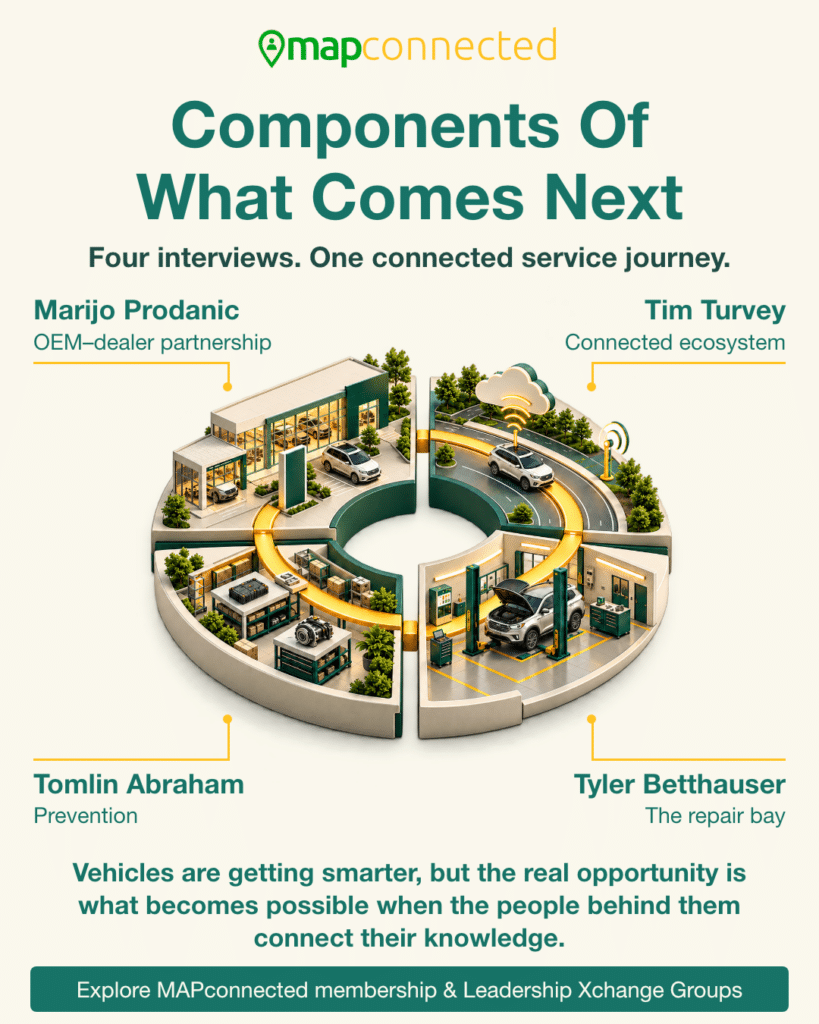
This is the second interview in Components Of What Comes Next, MAPconnected’s four-part interview series. In Interview One, Marijo Prodanic looked at what a manufacturer can learn from the technician doing the repair. Abraham follows that evidence one step further: when a supplier sees the same part coming back, can it get what the technician learned to the engineer who can change it?
Where does that handoff happen in your organization? MAPconnected’s Leadership Xchange Groups give service and warranty leaders a place to compare how they handle it.